Common Nighthawk Migration
I have always loved the common nighthawk. A sleek bird of variegated browns, silvers and golds, with a smallish body and a forked, longish tail. With a tiny bill, wide mouth, short neck and big eyes, the nighthawk appears big-headed as it sits at rest. White blazes on long, sharp, angular, narrow wings seem to glow in the dark as the bird swirls and bops like a bat through the sky.
I have been lucky to experience day and nighttime gatherings of nighthawks during their fall migration — a pre-dawn hike to the rocky Myrtle Point on Mt. Le Conte; while watching the sunset on a pier overlooking the salt marsh at Dauphin Island; and while hiking on the sandstone glades in DeSoto State Park atop Lookout Mountain — what a spectacular aerial show these birds exhibit! It’s exciting to be in the middle of the activity, hearing the sounds of swooshing, beeping, peenting and booming, and feeling the buzz and frenzy as the birds dart, dash and dive, eating insects on the go. Every fall, my husband and I wish for repeat performances of past experiences, and for our anniversary date night in late September, we visit Vulcan Park in Birmingham to watch the nighthawks orbit above the spearpoint of the giant god of fire and forge statue. We look for the birds in the beams of city lights above the tall downtown buildings as well.
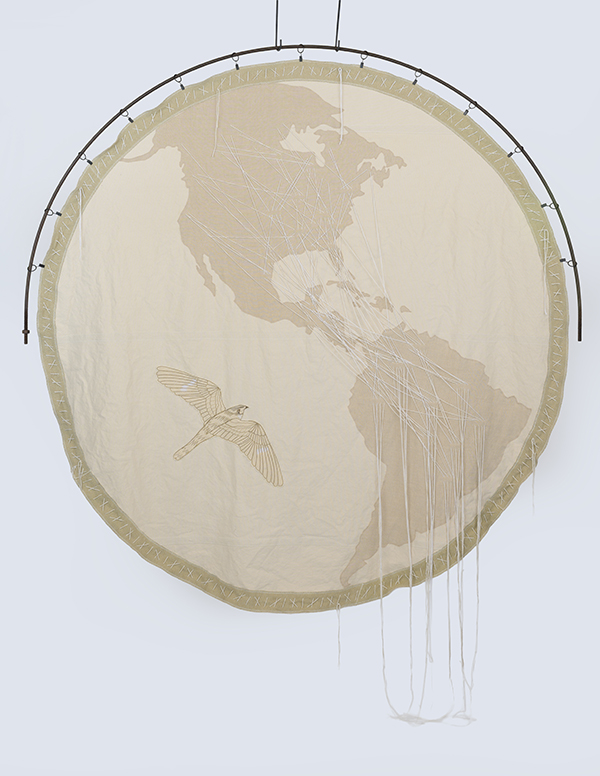
Common nighthawk migration is one of the longest of our American birds — 1600-4000 miles! From various breeding locations across North America, they begin their autumn journeys south. Crossing paths with other nighthawks, mingling and connecting during stopovers, sharing resources the land, water and air provide, they pick paths that offer them the best feeding grounds. Some will fly over land through Mexico, the Yucatan Peninsula and Central America, and eventually make their way to South America. Some will fly straight over the Gulf of Mexico and the Caribbean Sea, making stopovers in Cuba and the Caribbean Islands before reaching their winter roosts. Others from the East Coast will fly non-stop over the Atlantic Ocean to South America. While in their wintering grounds, where its warmer near the Equator, the crossing of paths and mingling with other populations continue.
I often worry about the perils nighthawks face along their migration as well as around their summer and winter homes. The common nighthawk is a grassland species, and as many grassland birds, populations are in steep decline. Changes in land use, the overuse of pesticides, climate-change, as well as other factors continue to affect habitat and food availability. Over time, nighthawks have had to shift and adapt to varying nesting, foraging, and roosting habitats to include woodlands, wetlands, farmland, as well as urban and suburban centers. Breeding once took place in sparsely vegetated, grassy grounds, but now the birds have adapted to nesting on gravely flat rooftops and forest clearings. Even though the birds have adapted to these human-caused changes, the perils and uncertainties will continue to persist.
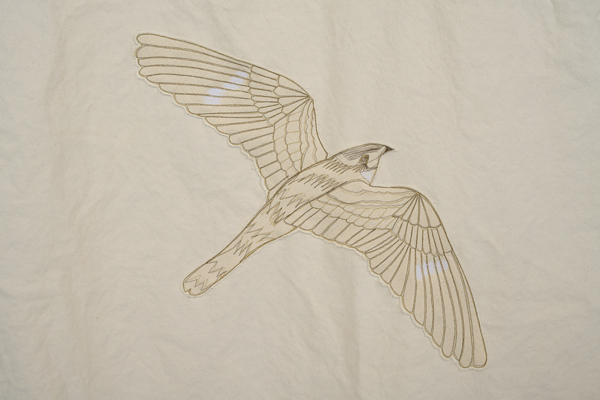
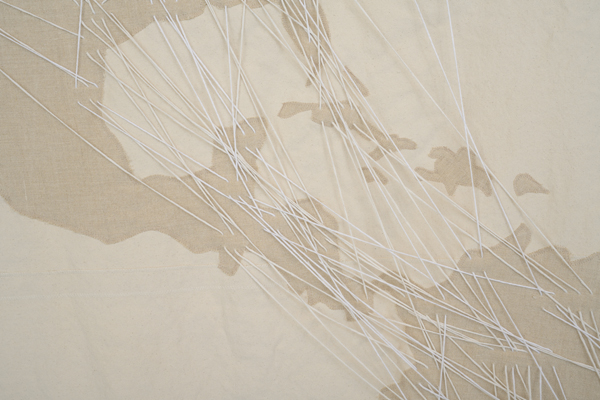
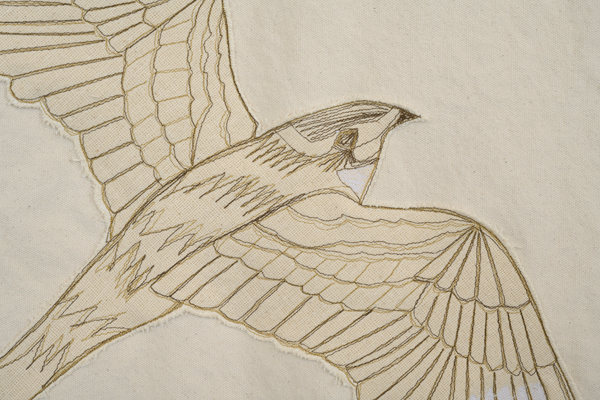
Migration is nature, and nature is borderless. In this piece, I have depicted the common nighthawk as a ghost bird to symbolize the decline of the species. Strings follow migration paths from North American breeding grounds to winter roosting spots in South America. Birds cross paths along the way, connecting to the land and to each other. I have left the strings loose at the end of the fall journeys to symbolize the uncertainties of return flight.